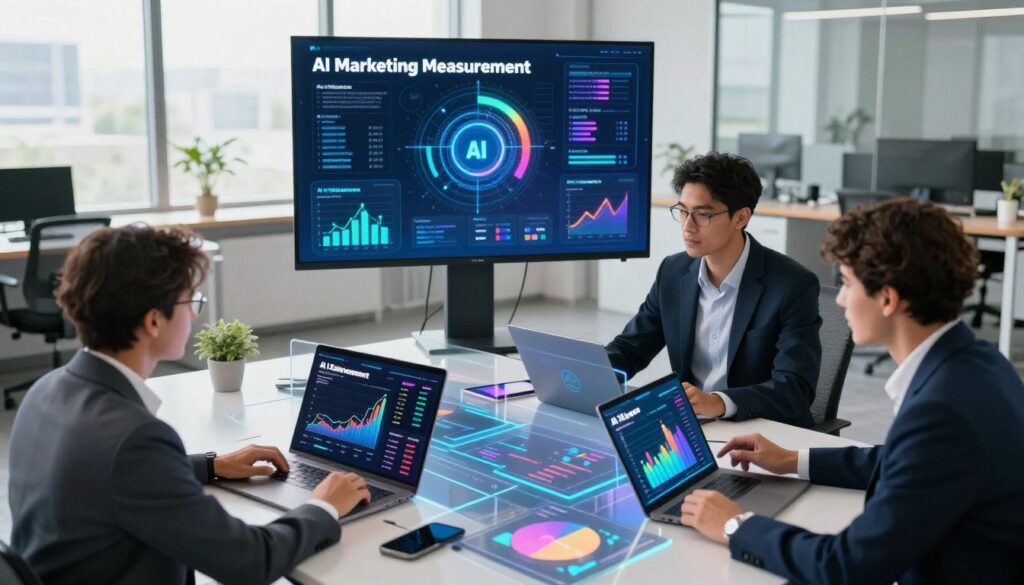
Are you really getting a return on your digital work, or just guessing? By 2024, McKinsey says 72% of businesses use automated tools to grow. This change affects how small business owners and creators work every day.
By moving away from manual data entry, you can focus on important strategies. This includes search engine optimization and writing copy that converts. With a clear plan for AI marketing measurement, your digital efforts can lead to real money. This way, you avoid wasting time on strategies that don’t work.
Modern tech is a great tool for being efficient, not a replacement for your own strategy. Tracking your progress well gives you the confidence to grow your brand. Data-driven decisions are the quickest way to lasting success online.
Be smart and stay ahead, Ray Baker.
Quick Answer: How to Measure AI Marketing
To measure AI marketing well, you need to look beyond simple numbers. AI systems don’t just report on past results. They predict what will happen next.
AI marketing measurement uses special tools like machine learning and NLP. These tools quickly sort through lots of data. They give you insights that humans might miss.
With AI marketing analytics, you can stop just reacting. You can start making decisions based on data. This can really help your business grow.
The main aim is to keep improving your strategy with new insights. When you measure AI marketing this way, your data becomes a key to success and growth.
Why Activity Is Not the Same as Results
Many marketing teams think more is better. They believe making lots of content means they’re growing. But, just making lots of posts doesn’t mean you’re actually growing your business.
Automation tools can make many posts fast. But, just having lots of posts doesn’t mean you’re getting more customers or making more money. Success is about getting leads, making sales, and keeping customers happy.
Being efficient is good, but it’s not everything. Research shows teams can spend 30% less time on tasks when they use automation. This lets them focus on planning and strategy.
But, using AI just to make more content can be a problem. If your content doesn’t connect with people, it’s just noise. It doesn’t help your business grow. Every piece of content should help move people through your sales process.
Efficiency is only good if it helps your business grow. Focus on making content that matters, not just fast content. By aligning your automated work with your goals, you can grow your business in a lasting way.
Metrics That Matter for AI-Assisted Marketing
To really see how you’re growing, look beyond simple numbers. Focus on AI marketing KPIs. Basic numbers like likes and shares are easy to see. But they don’t show the real effect of your AI tools.
You should look at data that shows how your business is doing financially. This is key to understanding your success.
Predictive models are key for today’s businesses. They use past data and AI to guess what will happen next. This includes things like sales and how long customers will stay with you.
By using these predictions, you can focus on what’s going to happen next. This is more important than what happened before.

Want to Use AI More Effectively in Your Business?
AI XLence gives small business owners practical ways to save time, improve productivity, reduce workload, and grow revenue using AI.
Explore AI XLenceWhen checking your AI campaign metrics, see how well your tools score leads. Good AI can tell you which leads are most likely to buy. This lets your sales team work smarter, not harder.
This makes your team more efficient. It also means you sell more.
Also, look at how well your AI emails work. Instead of just seeing if people open them, check if they click on what you suggest. This shows if your emails really connect with people or if your AI needs to get better.
The table below shows how tracking changes with AI:
| Metric Category | Traditional Focus | AI-Driven Focus |
|---|---|---|
| Lead Generation | Total Lead Volume | Predictive Lead Quality |
| Email Marketing | Generic Open Rates | Personalized Conversion Rate |
| Customer Value | Historical Revenue | Predicted Lifetime Value |
| Campaign ROI | Manual Cost Analysis | Automated Profit Forecasting |
By focusing on these specific signs, you can see what works and what doesn’t. Keeping an eye on these AI marketing KPIs makes sure your tech is worth it. It’s not just a big expense.
How AI Can Help Interpret Performance
Advanced technology connects raw data to strategic growth. With marketing performance AI, businesses turn big data into clear stories. This makes daily operations easier to understand.
Old analytics struggle with unstructured data, but new tools do great. AI digs into images, videos, and social media to show how people see your brand. These insights are deeper than what spreadsheets can offer.
Machine learning finds patterns in customer behavior that humans miss. These systems spot small changes in how people engage. With marketing performance AI, your team can catch trends early.
These insights help you improve your content strategy. You can make messages fit specific groups, making sure your campaigns hit the mark. This personal touch is key in a busy online world.
Using marketing performance AI helps you make smart choices with current data. It makes your marketing team quick to adapt. This keeps your efforts fresh and effective in a fast-changing market.
How to Avoid False Confidence in AI Reports
Knowing the limits of AI is key to getting real marketing performance AI insights. AI tools are fast and cover a lot of ground. But, they can hide errors in logic or data. Relying too much on them can harm your strategy in the long run.
Another big risk is bias in the training data. If AI learns from biased data, it might show unfair results. This can lead to bad decisions that push away your audience.
To keep your marketing performance AI top-notch, add human checks. Automated reports are just the start. Marketers should check these reports against real data and market trends.
“The goal is to use AI to augment human intelligence, not to replace the critical thinking required to interpret complex market dynamics.”
Before spending a lot on a new plan, check if AI insights match your brand. If a suggestion seems off, look into the data. Make sure the AI isn’t making mistakes.
By being careful, your marketing performance AI stays good and fair. A mix of tech and human insight keeps your strategy smart and in control.
Simple AI Marketing Measurement Plan
Creating a solid AI marketing measurement plan is easy. Just break it down into simple steps. This way, your tech investments will really help your business grow. A clear plan keeps you focused on what’s important for your company.
“Strategy is about making choices, trade-offs; it’s about deliberately choosing to be different.”
Want to Use AI More Effectively in Your Business?
AI XLence gives small business owners practical ways to save time, improve productivity, reduce workload, and grow revenue using AI.
Explore AI XLence
To start, follow these five key steps:
- Set Clear Goals: Know what you want to achieve, like better conversion rates or quality leads.
- Hire or Train Talent: Make sure your team can handle and understand AI insights.
- Ensure Data Quality: Good, clean data is key for a successful AI marketing measurement plan.
- Choose the Right Tool: Pick software that fits your business needs, not just the latest trends.
- Monitor Performance: Keep checking your results to make sure your AI efforts match your goals.

Don’t forget the last step: keep watching your metrics. Treat your AI marketing measurement as an ongoing task. Regular checks help you tweak your strategies and keep your marketing on track.
Common Measurement Mistakes
Many businesses struggle to measure AI marketing success. They often overlook basic data principles. The main problem is not the technology, but a lack of education and training.
Teams fail to align their technical output with business goals. This is because they don’t have a clear strategy.
Ignoring the quality of your input data is a big mistake. If your data is bad, your AI campaign metrics will show a wrong picture. Remember, garbage in, garbage out is true in data science and marketing.
Not setting meaningful benchmarks before starting new projects is another error. Without a baseline, you can’t tell if your efforts are improving. Setting clear performance targets helps you see real growth, not just random changes.
Many organizations lack the talent to understand complex outputs. Trying to measure AI marketing without knowing the models can lead to false confidence. This results in strategies that waste money and time.
To avoid these mistakes, build a culture of data literacy in your marketing team. Make sure your team knows how to check AI campaign metrics against real results. Focus on accuracy over speed to support your growth goals.
FAQ
It’s key to know how well your automated work is doing for long-term success. Many people want clear ways to measure AI marketing to make sure it meets their business goals.
How do I measure AI marketing results?
To track your results well, you need to link your tools to one dashboard. AI uses Natural Language Processing (NLP) to see how people feel about your brand.
By looking at both qualitative and quantitative data, you get a full view of your campaign’s health. This way, you avoid just focusing on numbers.
What KPIs matter for AI marketing?
Choosing the right AI marketing KPIs is key to showing your tech’s value. Look for metrics that link directly to money and keeping customers, not just activity.
- Conversion Rate: The percentage of users taking a desired action.
- Customer Acquisition Cost (CAC): The total spend required to gain a new lead.
- Sentiment Score: The emotional tone detected by NLP tools.
- Churn Rate: How well your automated efforts keep customers.
Can AI calculate marketing ROI?
Yes, AI is great at figuring out AI ROI marketing by making complex attribution models easier. It follows the customer’s journey to see which interactions are most valuable.
This lets you know which channels bring in the most profit. Here’s a table to show how AI compares to old ways:
| Feature | Traditional Tracking | AI-Driven Analysis |
|---|---|---|
| Data Speed | Manual/Slow | Real-time |
| Attribution | Single-touch | Multi-touch |
| Sentiment | Not available | Automated NLP |
How do I know if AI content is working?
To see if your content is working, watch for changes in how people engage and convert. If your AI content is good, you should see more qualified leads and fewer people leaving your site.
Always compare your results to a baseline before using new tools. Seeing steady growth in these areas means your AI ROI marketing is working.
Want to Use AI More Effectively in Your Business?
AI XLence gives small business owners practical ways to save time, improve productivity, reduce workload, and grow revenue using AI.
Explore AI XLenceConclusion
Modern marketing needs a new way of looking at performance. Artificial intelligence gives us tools to track growth. But, we need human help to make it truly valuable.
Brands like Salesforce and HubSpot prove that technology works best with human guidance. You should be the main planner of your strategy. Let software handle the data work.
This mix keeps your campaigns focused on real goals, not just numbers. Building a strong edge in the market takes time and effort. Work on making your measurement better to find what really boosts sales.
By focusing on accurate data, your brand will stand out online. Take charge of your data now to improve your efficiency. Stay ahead, Ray Baker.
FAQ
How do I measure AI marketing results?
What KPIs matter for AI marketing?
Can AI calculate marketing ROI?
How do I know if AI content is working?
How can I improve my marketing performance AI tracking?
What are the best AI campaign metrics for small businesses?
Want to Use AI More Effectively in Your Business?
AI XLence gives small business owners practical ways to save time, improve productivity, reduce workload, and grow revenue using AI.